If your child screams through haircuts, somebody has already told you to try bribery, a tablet, and a lollipop — and you have already tried all three. This is not that article.
Fear of haircuts is common, it almost always has an identifiable cause, and the cause is almost never “being dramatic.” Figuring out which cause you are dealing with is most of the solution.
Find the actual trigger
“Scared of haircuts” is a bundle of at least six different things. Watch closely next time and see which one sets it off:
- The sound. Clippers are loud, and the pitch sits in a range a lot of children find genuinely unpleasant. If the crying starts when the clipper switches on and stops when it switches off, this is your answer.
- The vibration. Separate from the sound. Some kids are fine with the noise across the room and cannot tolerate the buzz against their skull.
- The cape. A snug band around the neck is restraining, and for a child who does not like being restrained, the haircut is over before it starts.
- Hair on the skin. Fine cut hair itches. For a sensory-sensitive child this is not a minor annoyance — it is the whole problem.
- Being approached from behind. A stranger standing behind you touching your head is unnerving, if you think about it plainly.
- The mirror. A few children find watching themselves be worked on distressing. Turning the chair away solves it instantly.
You can test most of these at home in a few minutes. That is worth more than any amount of reassurance.
What to do at home, over a week or two
Desensitization works, but only if it is slow and boring. Rushing it confirms the fear.
- Day one: clippers or scissors visible on the table, switched off. Nothing else happens.
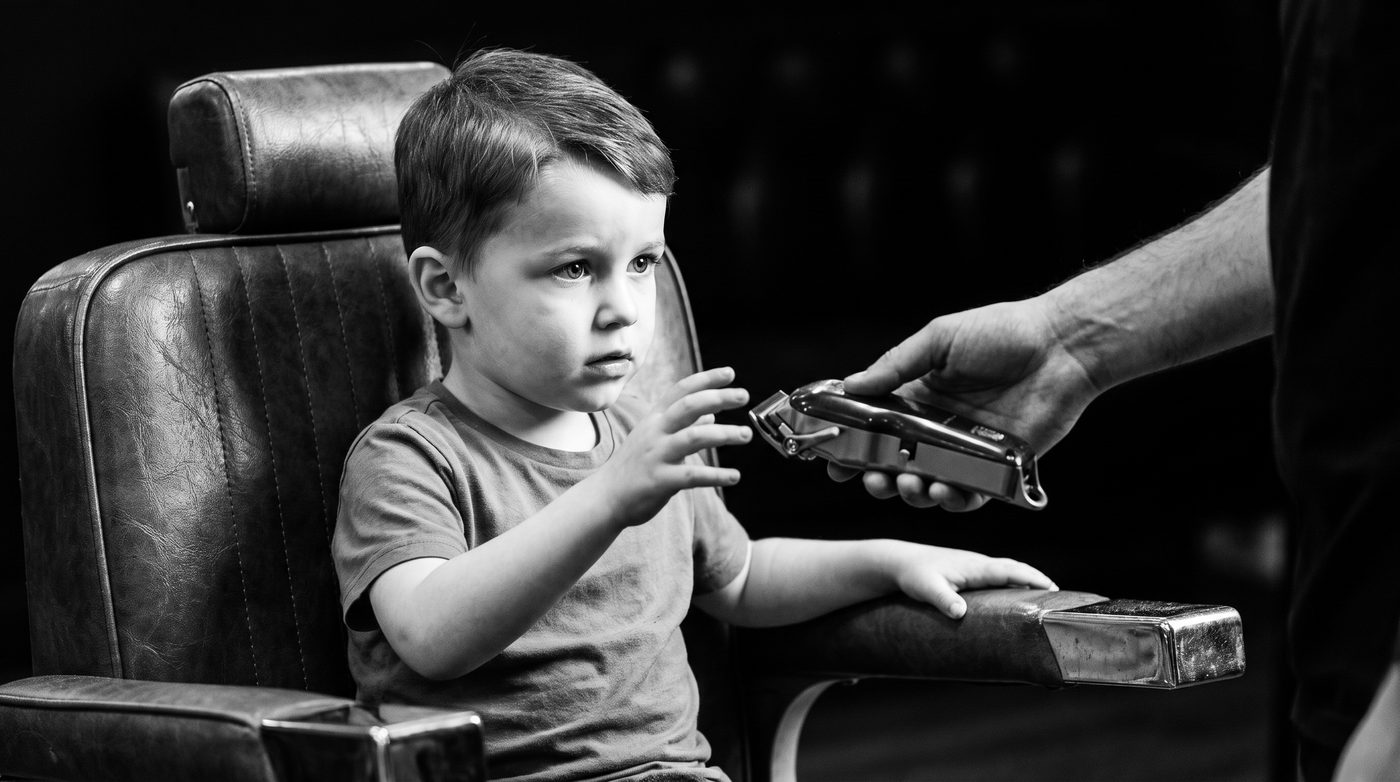
- Day two or three: let them hold the clippers, switched off. Let them switch them on themselves if they want.
- Day four or five: clippers running across the room while they do something else.
- Then: clippers running, held near their arm or hand — not their head.
- Then: briefly against the back of the neck. One second, then off.
Practice the cape separately. Drape a towel over them at dinner. Let them wear it and take it off themselves.
Let your child control the on-switch wherever possible. Control is the active ingredient here — a noise you can stop is far less frightening than the same noise happening to you.
Things that help in the chair
- Come first thing in the morning, when the shop is quiet and your kid is fresh. Tell us what you are dealing with when you book and we will keep the music off — or put their favorite show on the TV.
- Book the same barber every time. Familiarity does more than any technique.
- Ask for scissors only. A full scissor cut removes the two biggest triggers at once.
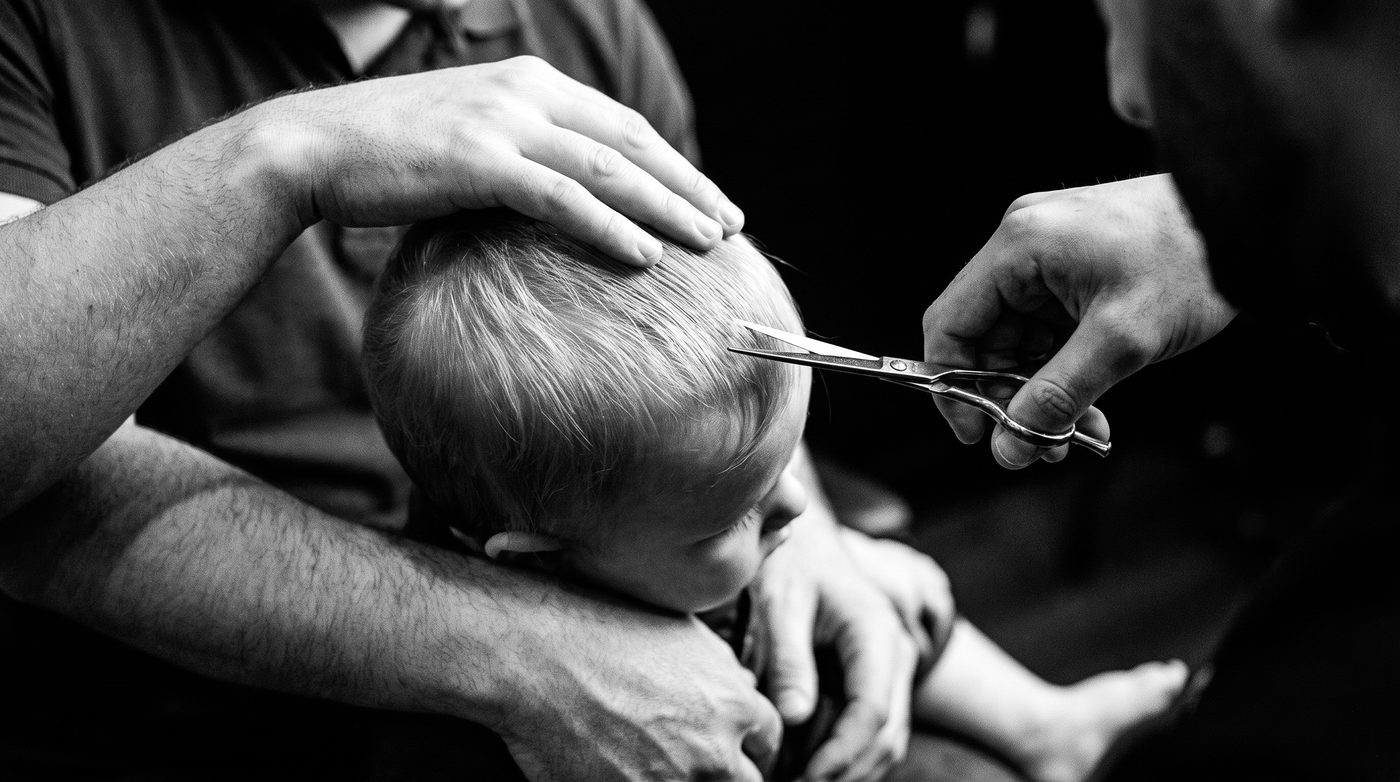
- Sit them on your lap and let them face you, not the mirror. Every tool we use is cordless, so the cut happens wherever your child is comfortable.
- Ask the barber to narrate — “I’m going to comb the back now” — or to say nothing at all, depending on your child.
- Agree on a stop signal beforehand. A raised hand works. Then honor it, immediately, the first time they use it. That is the thing that builds trust.
Things to stop doing
Some of the standard advice actively makes it worse.
- Do not hold them down. It may get you through today’s haircut, and it will cost you the next five.
- Do not promise it will be quick and then let it run long. Once you have broken that, nothing you say next time carries weight.
- Do not apologize on the way in. “I’m so sorry, I know you hate this” tells them there is something here to be afraid of.
- Do not save it up. Longer gaps mean longer haircuts, which is exactly the wrong direction. Short, frequent, easy visits beat rare, long, difficult ones.
- Do not make the tablet the whole strategy. It works, until it does not — and it tilts the head down, which makes the cut harder and the appointment longer.
Try a visit with no haircut
The most effective single thing we do: come in, look around, sit in the chair, spin around, meet the barber, leave. No cut. Five minutes. Free, at both shops — just call ahead so we know to expect you.
It turns the shop from an unknown place where a bad thing happens into a known place. For a lot of children, the second visit — the one where the haircut actually happens — goes fine purely because they have been there before.
When it is more than nerves
If your child is autistic, has a sensory processing difference, or has had a genuinely bad experience with a haircut, general tips only take you so far. That situation needs a shop that will set the appointment up differently from the start — a quieter slot, a longer booking, no clippers, no pressure to finish.
We have written a full rundown of how we handle sensory-friendly appointments, and it is worth reading before you book.
What changes with age
Under two
Almost always about restraint and unfamiliarity rather than fear of the haircut itself. Lap sitting, scissors only, no cape, and keep it under ten minutes. Distraction works well at this age and there is no reason not to use it. If this is the very first cut, our first haircut guide covers the whole visit.
Two to four
The hardest window, and it lands at exactly the age when children want control over everything. Give them as many real choices as you can — which chair, cape or no cape, comb first or spray first. Not “do you want a haircut,” because that one has a wrong answer.
Five to seven
Old enough to be reasoned with and to remember. This is the age where the pre-visit and the stop signal work best, and where being treated like a customer rather than a task starts to matter to them.
Eight and up
Ongoing haircut distress at this age usually has a specific cause — a bad experience, a sensory issue, or self-consciousness about how they look. Ask directly and privately. Often the problem turns out to be the outcome rather than the process: they are worried about what the haircut will look like, not about having it.
When it is really about the result
Worth separating out, because the fix is completely different. A child who is anxious about how they will look afterward is not helped by a quieter room or a gentler barber. They are helped by being given control of the decision.
Let them pick the photo. Let them ask for it themselves. Ask us to check in with them, not you, halfway through. And take less off than you think — for a self-conscious kid, an underwhelming haircut they chose beats a great one that surprised them.
The long view
For most children, haircut fear peaks somewhere between two and four and fades over the following year or two. The children who take longest are almost always the ones for whom haircuts have consistently been a struggle they lost — which is the argument for stopping early, stopping often, and never forcing it through.
Six calm partial haircuts get you to an easy kid faster than two complete ones that ended badly. Each haircut that ends calmly, even unfinished, makes the next one easier; each one that ends in a struggle sets you back three. An unfinished haircut is not a failed appointment.
Our shops are in Williamsville and Tonawanda, both at 716-389-0192. Walk-ins are welcome when there is an open chair, but for a nervous kid, book — book online or call, tell us what you are dealing with, and we will set the visit up properly.