
If you have started reading about traditional shaving, you have probably run into the debate: straight razor or safety razor? Both are old-school, both give a better shave than most people get from a cartridge, and both have devoted fans.
We use a straight razor every day — it finishes the outline on every Classic haircut at our shops. So here is the honest view from the chair: what each one is, what each one is good at, and which one you should actually use at home.
The two razors
Straight razor
A single, long, open blade that folds into a handle. The barber’s tool you see in old photos. Traditional straight razors are honed and stropped; many barbers now use straight razors with replaceable blades for hygiene, so a fresh blade goes in for each client.
Safety razor
A handle with a head that holds a double-edged blade, with only a small strip of blade exposed. The guard makes it much harder to cut yourself. Blades are cheap and replaceable.
Closeness
Edge: straight razor. In skilled hands, a straight razor gives the closest shave there is. A safety razor comes very close — closer than most cartridge razors — but the guard limits how near the blade can get.
Learning curve
Edge: safety razor, by a mile. A safety razor takes a week or two to get comfortable with. A straight razor takes real practice: blade angle, skin tension and steady hands. Barbers train for this. Most people at home do not need to.
Risk of cuts
Edge: safety razor. The guard protects you. Nicks happen while you learn, but serious cuts are rare. A straight razor is unforgiving if you are careless.
Irritation and razor bumps
Roughly a tie, with a caveat. Both single-blade razors are often gentler than multi-blade cartridges, because there is only one pass of a blade rather than several. Technique matters more than the tool: soften the hair, use lather, shave with the grain, and do not press. The Mayo Clinic’s page on ingrown hair recommends a sharp single blade and shaving with the direction of growth for people prone to bumps.
Cost
Edge: safety razor. A decent safety razor handle and a pack of blades costs little, and blades last a few shaves each. A good traditional straight razor costs more up front and needs stropping and honing; a replaceable-blade straight razor is cheaper but still harder to use.
Upkeep
Edge: safety razor. Rinse, dry, change the blade when it pulls. A traditional straight razor needs regular stropping before use and occasional honing, and must be dried carefully to prevent rust.
Speed
Edge: safety razor for most people. Once you know what you are doing, a safety razor shave takes about as long as a cartridge shave. A straight razor shave is slower and more deliberate.
The verdict for home shaving
For almost everyone, a safety razor is the right choice at home. You get most of the closeness of a straight razor, much less risk, lower cost and very little maintenance.
A straight razor is wonderful — in a barber’s hand. If you want the experience of a straight-razor shave, the easiest and safest way is to let a barber do it.
How to shave with a safety razor
- Prep: shave after a warm shower, or hold a warm, damp towel on your face for a minute.
- Lather: use a proper shaving cream or soap and a brush if you have one. It lifts the hairs.
- Angle: hold the razor at roughly 30 degrees to your skin. Let the weight of the razor do the work; do not press.
- Direction: the first pass goes with the grain.
- Short strokes: rinse the razor often.
- Second pass (optional): relather and go across the grain for a closer shave. Skip it if your skin is sensitive.
- Finish: rinse with cool water, pat dry, apply a soothing aftershave balm.
Pre-shave oil, cream and balm
- Pre-shave oil adds a thin protective layer and softens the hair. Helpful for sensitive skin and thick stubble.
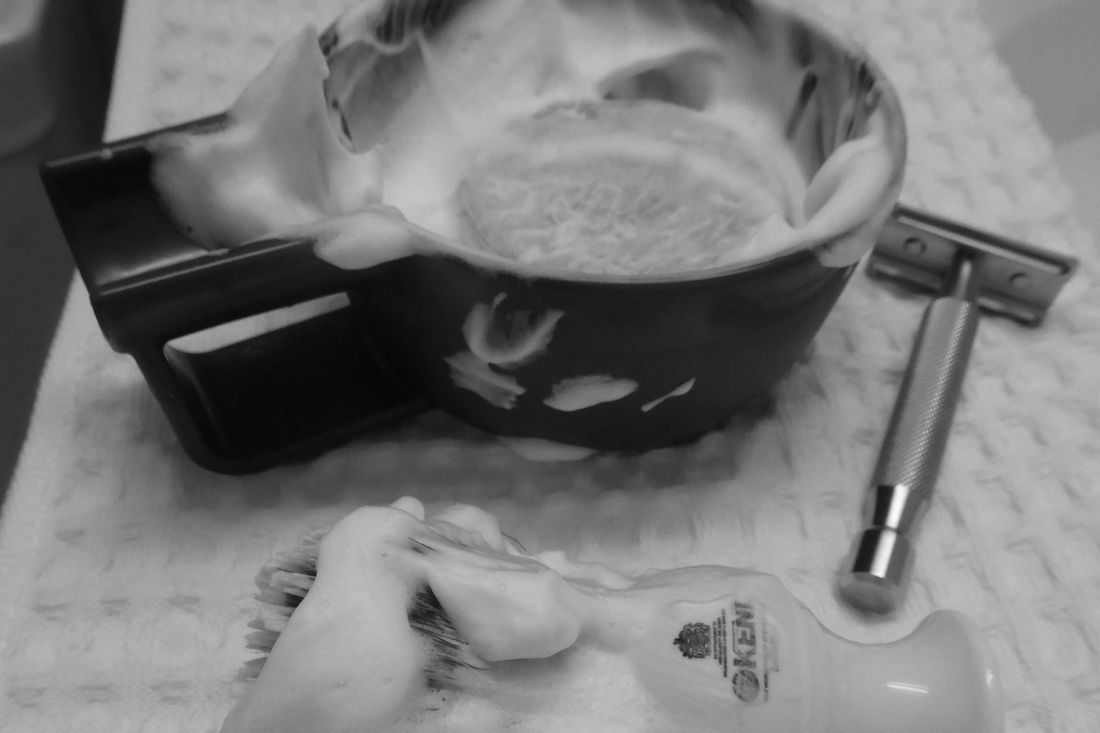
- Shaving cream or soap provides cushion and glide. A brush helps build a richer lather.
- Aftershave balm soothes and moisturizes. Alcohol-heavy aftershaves can sting and dry the skin.
If you react to products easily, patch-test first; the FDA’s page on allergens in cosmetics is a useful read.
Shaving the neck
The neck is the trickiest area for any razor, because the hair often grows in several directions. Map your grain first by running your fingers across the stubble; shave with it; and keep the skin taut. If you wear a beard, see our guide to the beard neckline for where to stop.
Choosing a safety razor
- Closed comb vs. open comb: closed comb heads are gentler and better for beginners. Open comb heads are more aggressive and suit heavier stubble.
- Weight: a heavier razor does more of the work for you, which helps you avoid pressing.
- Handle length: longer handles suit bigger hands; shorter ones give more control on the face.
- Adjustable heads: let you change how much blade is exposed. Useful, but not necessary to start.
- Blades: different blades feel very different. Try a few before settling on one.
Common first-week mistakes
- Pressing too hard. The number one cause of nicks and irritation. Let the razor’s weight do the work.
- Wrong angle. Too steep and it scrapes; too flat and it does not cut. About 30 degrees.
- Skipping prep. Dry, cold stubble is hard on any blade.
- Going against the grain first. Always with the grain on the first pass.
- Using a dull blade. If it pulls, change it. Blades are cheap; skin is not.
Electric razors, briefly
Electric razors are not part of this debate, but they are worth a mention. They are fast and convenient and rarely cut you, but they do not shave as close as a blade. Many people use an electric during the week and a safety razor at the weekend, or keep stubble with a trimmer and only shave properly for occasions.
Why barbers use straight razors
A straight razor gives the crispest possible edge, which is why it is used for the final outline on haircuts — around the ears, across the neckline and on beard lines. Barbers spend years getting the angle and pressure right, and they can see and stretch your skin in ways you cannot in a mirror. Every Classic at our shops is finished with an edger and a straight razor for exactly that reason.

What a barber’s shave does differently
When a barber shaves you, they have three advantages you do not: they can see every angle of your face, they can stretch your skin with one hand while shaving with the other, and they have done it thousands of times. That is why a barber shave can be both closer and gentler than most home shaves. Our hot towel shave guide walks through every step, from the first hot towel to the aftercare.
A note on hygiene
Whatever you shave with at home, keep it to yourself. Do not share razors, rinse well after every pass, let the razor dry fully between shaves, and replace blades before they get dull or rusty. Store it somewhere dry rather than in the shower.
Which razor for which job
- Everyday face shave at home: safety razor.
- Cleaning up around a beard or mustache: a safety razor, or a trimmer for the outline.
- Neck between haircuts: a safety razor, carefully, with the grain — or an Edge Up at the shop.
- A special-occasion shave: a barber’s straight-razor work.
- Very sensitive, bump-prone skin: a safety razor with a gentle head, or a trimmer that leaves a little stubble.
The barber option
If you want a straight-razor-level shave without the learning curve, book a Hot Towel Shave: pre-shave oil, hot lather, hot towels and aftercare, about thirty minutes, from $25. If you only want a clean neck and outline, the Edge Up (from $12) includes a neck shave.
The cheat sheet
- Closest shave: straight razor, in skilled hands.
- Best for home: safety razor.
- Least risk: safety razor.
- Lowest cost and upkeep: safety razor.
- Technique beats tool: prep, lather, 30 degrees, no pressure, with the grain.
- Special occasions: book a Hot Towel Shave.
At the Tonawanda shop
Dorian Mayham (master barber), and Sam Balesteri and Zaid Blasiny (licensed New York State barbers) do straight-razor work every day. The shop is at 578 Delaware St., Tonawanda, open Tuesday through Friday 7AM to 7PM and Saturday 8AM to 1PM. Walk-ins are welcome when there is an open chair — appointments are encouraged, so call 716-389-0192 to confirm someone is free.
Book online. Try a barber’s straight-razor shave once, then decide whether you want to chase it at home. Most people find a safety razor during the week and a Hot Towel Shave for special occasions is the perfect mix.