If you have curly hair, there is a decent chance someone, somewhere, has cut it like it was straight. It looked fine in the chair. Then you washed it, it dried, and it sprang into a shape nobody planned for.
Curly hair is not difficult. It just needs to be cut by someone who knows that curls shrink, bunch and move differently from straight hair. Get that right, and curly hair is one of the easiest kinds of hair to wear — it has texture and volume built in, and needs almost no styling.
This guide goes through the cuts that work for each curl type, how a good curly cut is done, and how to look after your hair between visits.
First, know your curl type
You will see curl types described with numbers and letters. You do not need the details, just the three broad groups:
- Wavy: loose S-shaped waves. Can look straight when wet and wavy when dry. Prone to frizz.
- Curly: defined ringlets or spirals, from loose loops to tight corkscrews. Shrinks noticeably when dry.
- Coily: tight coils or zig-zag patterns. Dense, shrinks a lot when dry, and tends to be the driest hair type.
Most heads have more than one pattern — tighter at the nape, looser on top, for example. A good barber reads the whole head.
Why curly hair needs a different approach
Shrinkage
Curly hair looks much shorter dry than it does wet or stretched out. Cut it straight and wet without allowing for that, and the top ends up much shorter than you wanted. Good barbers cut curly hair a bit longer than it looks like it needs, or cut it partly dry.
Curls clump
Curls group together into clumps. A cut that ignores the clumps leaves holes and odd shapes when the hair dries. Cutting with the curls — following where they naturally fall — gives a cleaner shape.
Bulk sits at the sides
Left alone, curly hair grows out as well as down, so the sides get wide. That is why so many great curly cuts keep the sides shorter than the top.
The cuts that work — wavy hair
Textured taper with length on top
Tapered sides, two to four inches on top, cut to encourage the waves. Push it back or let it fall forward. Very low maintenance.
Medium-length layered cut
Ear-length or a bit longer, with layers so the waves fall naturally rather than puffing out. Scissor work does most of the job here.
Short crop with waves on top
A low fade or taper with a short, textured top. Waves give it movement even when it is short.
The cuts that work — curly hair
Curly top with a fade
Probably the most popular curly cut there is: a low, mid or high fade on the sides, and a defined mass of curls on top. Clean sides, natural top. Our fade vs. taper guide helps you choose the sides.

Curly taper
The softer version: tapered sides that stop short of skin, with curls on top. Grows out more gently than a fade.
Longer curls, shaped
If you want length, the key is shape. Regular trims keep the curls round and even rather than triangle-shaped — narrow at the top and wide at the bottom.
Short curly crop
A very short top that still shows the curl pattern, with tapered sides. Great for people who like curls but not the volume.
The cuts that work — coily hair
High-top or shaped top with a fade
Short, crisp sides with a shaped, even top. Precise and sharp.
Short tapered cut
An even, short top with a taper at the sides and back and a clean outline. Classic and very easy to live with.
A fade under textured or twisted hair
If you wear texture or twists on top, a clean fade or taper at the sides frames it and keeps the overall shape tidy between visits.
Buzz with a sharp line-up
Short and even all over, with a crisp hairline. The line-up is what makes it look deliberate. Our edge up explainer covers how that is done.

Common curly-cut mistakes
- Cutting the top as short as it looks when wet. It springs up shorter than planned. Always allow for shrinkage.
- Thinning curls too much. Over-thinned curls lose their shape and frizz more. A little is fine; a lot rarely helps.
- Ignoring the sides. Even if you want long curls, the sides and back need attention or the shape goes wide.
- Cutting the same way as last time when the pattern has changed. Curl patterns can shift with the seasons, humidity and growth. Good barbers look at the hair in front of them.
- Blunt, one-length tops. They often create a heavy, rounded shape. Layering or point cutting lets curls sit naturally.
Curly hair and Buffalo weather
Western New York weather is hard on curls. Humid summers bring frizz; dry, heated winters bring brittleness. A few seasonal adjustments help:
- Summer: a slightly shorter cut and a light, humidity-resistant product.
- Winter: more conditioning, less washing, and a little extra length for warmth if you like.
- Hats: they flatten curls. A quick spritz of water and scrunch revives them afterward.
Scissors, clippers, or both?
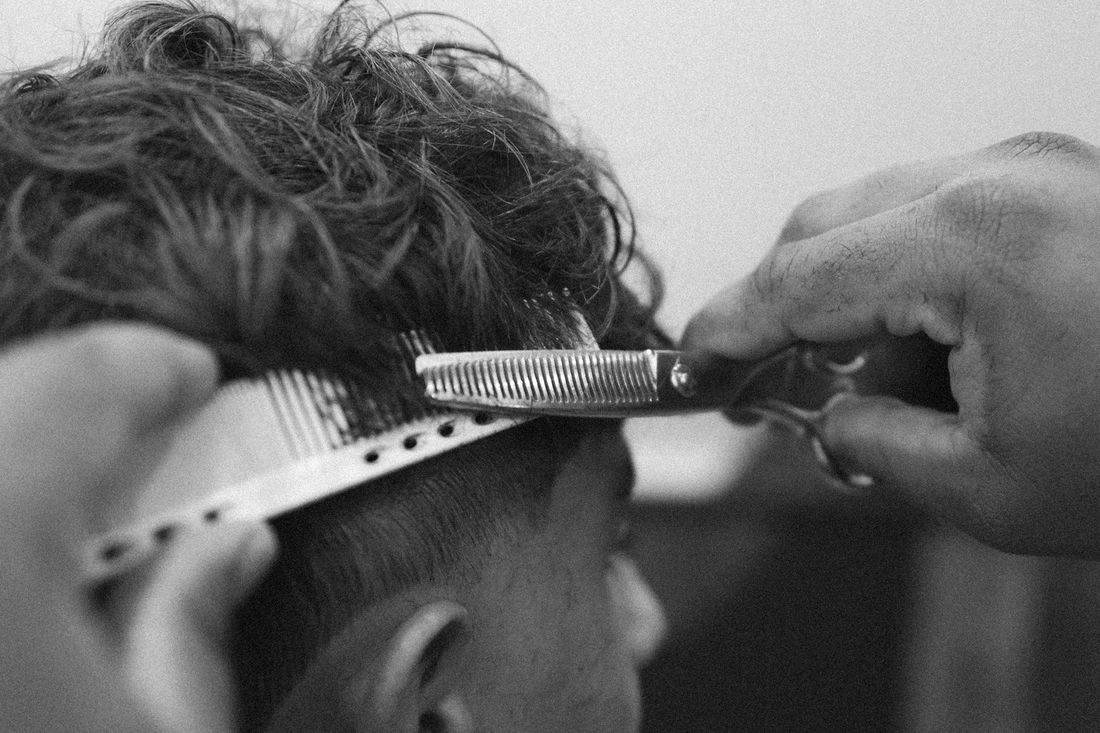
Most curly cuts use both. Clippers handle the sides and back; scissors handle the curls on top, where you want control over each section. Our post on scissor cuts vs. clipper cuts explains when each tool makes sense.
Looking after curly hair between cuts
- Wash less, condition more. Curly hair is drier than straight hair. Shampoo a few times a week and condition every time.
- Do not brush it dry. Brushing dry curls turns them into frizz. Detangle with fingers or a wide-tooth comb, ideally with conditioner in.
- Style it wet. Apply product to wet or damp hair and let it dry without touching it.
- Use a light product. A curl cream or leave-in conditioner is usually enough. Heavy gels can make curls crunchy.
- Pat, do not rub. Rubbing with a towel causes frizz. Pat or squeeze the water out instead.
- Sleep on it gently. Some people use a satin pillowcase to keep curls from frizzing overnight.
If you react to new products easily, patch-test first. The FDA has a useful page on allergens in cosmetics.
Curly beards
If your hair is curly, your beard probably is too, and curly beard hair is more likely to curl back into the skin after shaving or a very close trim. The Mayo Clinic’s page on ingrown hair explains why. If razor bumps are a problem, tell your barber so they can keep the line-up slightly less close. Our beard oil vs. balm guide helps with curly beards specifically.
How often to get it cut
- Curly top with a fade: every two to four weeks for the sides; the top can go longer.
- Curly taper: every four to six weeks.
- Longer curls: a shape-up every six to ten weeks.

Product guide by curl type
- Wavy: a light cream or sea-salt-style spray for texture. Heavy products flatten waves.
- Curly: a curl cream or leave-in conditioner, with a light gel on top if you want more hold and less frizz.
- Coily: richer moisturizers and oils, since coily hair tends to be the driest. Many people layer a leave-in, then a cream or butter.
- Short curly cuts: often just a small amount of cream, or nothing at all.
Whatever you use, start small. Too much product weighs curls down and makes them look greasy.
Growing out curly hair
If you are growing curls out, there is an awkward stage around the three-to-four-month mark when the sides get wide before the top has length. The fix is regular shaping: keep cleaning up the sides and back while leaving the top alone. It keeps the shape balanced the whole way through.
What to say to your barber
- “My hair shrinks a lot when it dries — please leave the top longer than it looks like it needs.”
- “I want the sides tight and the curls kept on top.”
- “I wear it air-dried with a bit of cream.”
- “Last time the top came out triangle-shaped.”
Come in with your hair in its normal, dry state if you can, so your barber can see your curl pattern as you actually wear it.
The Williamsville shop
Every cut on this list is a Classic at our shops — clippers, scissors, edger and straight razor, about thirty minutes, from $25. Classic & Beard, from $35, adds beard sculpting and line work. Jon Palmeri, Dave Scolla, Michael Falzone and Bryan Castronova cut every hair type at our Williamsville shop.
The shop is at 6100 Main St., open Tuesday through Friday 9AM to 6PM and Saturday 8AM to noon. Book online or call 716-389-0192. For more options, see our low-maintenance haircuts for men.